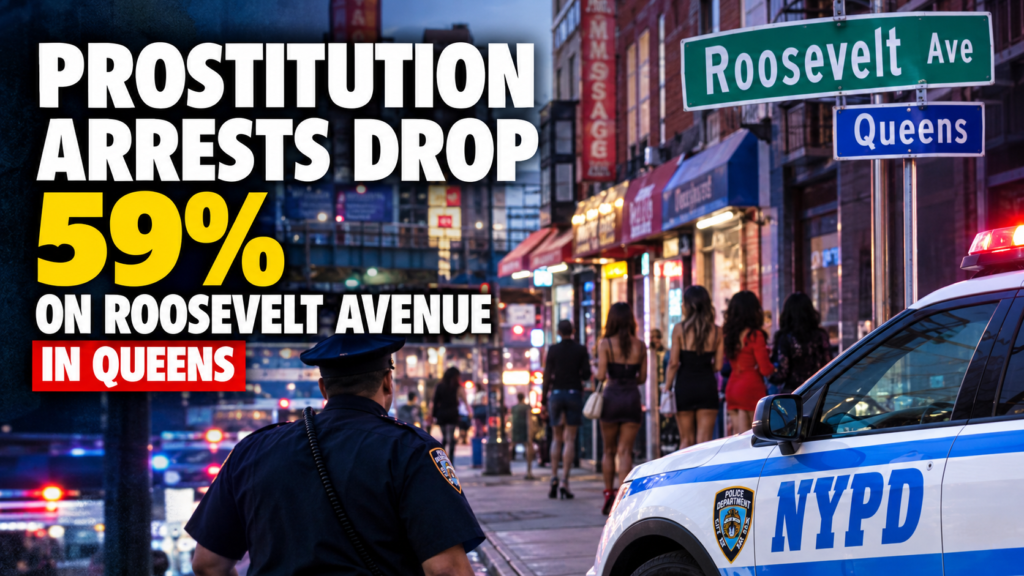
Prostitution-related arrests along Roosevelt Avenue in Queens, New York, have dropped sharply this year, while local residents, community leaders and law-enforcement sources continue to raise concerns about illegal prostitution and possible sex trafficking in the area.
According to police records cited in recent reporting, the NYPD recorded 193 prostitution-related arrests along Roosevelt Avenue through September 13, 2026. During the same period in 2025, there were 468 arrests.
That represents a decline of approximately 59%.
The figures have renewed debate over how authorities should address prostitution, illegal brothels, potential trafficking and other public-safety concerns along the busy Queens corridor.
What Is Happening Along Roosevelt Avenue?
Roosevelt Avenue, particularly sections around Jackson Heights and Corona, has long attracted attention because of street-based prostitution and businesses accused of operating as illegal brothels.
The area has sometimes been referred to as the “Market of Sweethearts” because of its reputation for street-level commercial sex activity.
Recent reporting described women approaching potential customers along portions of Roosevelt Avenue and offering illegal sexual services. Some alleged businesses operate inside commercial buildings located along the approximately two-mile corridor.
Community advocates have also raised concerns about whether some people involved in the sex trade may be victims of trafficking or exploitation.
Prostitution Arrests Have Dropped Significantly
NYPD records cited in the report show a substantial decline in prostitution-related arrests compared with the previous year.
| Period | Prostitution-related arrests |
|---|---|
| Jan. 1–Sept. 13, 2025 | 468 |
| Jan. 1–Sept. 13, 2026 | 193 |
| Change | About 59% decrease |
The decline follows a major enforcement campaign carried out in 2024 under the previous administration.
That effort, known as “Operation Restore Roosevelt,” targeted prostitution-related activity and illegal businesses along the avenue.
The latest numbers have prompted some community leaders to question whether enforcement activity has been reduced.
Community Leaders Raise Concerns
Former New York State Sen. Hiram Monserrate, who represents the affected neighborhoods as a local Democratic district leader, said he believes reduced enforcement has contributed to the problem.
Monserrate argued that prostitution and suspected trafficking activity have become more visible and said local residents need stronger action.
Other officials and community advocates have similarly expressed concerns about whether police have sufficient support and resources to address the activity.
However, these claims represent the views of individual community leaders and advocates and should be distinguished from independently established facts about the causes of the decline in arrests.
City Hall Responds
A representative for Mayor Zohran Mamdani said the administration is working with neighborhood residents and local organizations to address conditions along Roosevelt Avenue.
City Hall spokesman Sam Raskin said the administration’s approach combines law enforcement with support for people who may be victims or survivors of exploitation.
The administration has emphasized that addressing prostitution and trafficking requires both enforcement and services designed to help vulnerable people move toward safer and more stable circumstances.
Previous Enforcement Efforts
Roosevelt Avenue became the focus of increased police attention during the previous administration.
Authorities targeted suspected illegal brothels, prostitution activity and other businesses operating in the area.
The enforcement campaign resulted in numerous arrests and was credited by officials at the time with reducing some of the visible activity along the corridor.
The latest arrest figures, however, show that fewer prostitution-related arrests have been recorded during the comparable period in 2026.
A decline in arrests does not by itself establish whether prostitution activity has increased or decreased, because arrest numbers can also be affected by enforcement priorities, police operations, investigative methods and changes in reporting.
Some Arrests Involved Alleged Customers
The enforcement effort has also focused on people accused of attempting to purchase sexual services.
According to police sources cited in the report, John Maddox, 52, was arrested July 29 near 98th Street after allegedly offering money to an undercover officer for sex.
Another man, Mario Sanchez, 31, was arrested June 11 near 80th Street after allegedly offering money to an undercover officer.
Both were reportedly charged with patronizing prostitution and pleaded not guilty.
Because the cases remain allegations, the defendants are presumed innocent unless proven guilty in court.
Other Crime Along the Corridor
The report also noted that major crimes such as murders and shootings along the same corridor were down approximately 3%.
That figure provides a broader picture of crime trends in the area, although different categories of crime can move in different directions and should not necessarily be interpreted as evidence of a direct relationship with prostitution enforcement.
Why Roosevelt Avenue Remains a Focus
The debate surrounding Roosevelt Avenue involves several overlapping issues:
- Illegal prostitution
- Suspected human trafficking
- Illegal brothel operations
- Public safety
- Police enforcement
- Support services for vulnerable people
- The impact of changes in state and city policies
New York lawmakers repealed a state law in 2021 that had criminalized loitering for the purpose of prostitution. The change altered how police could approach certain street-level activity.
Supporters and critics of the change have disagreed over its impact, making prostitution enforcement a continuing subject of political and community debate.
What Happens Next?
The future of Roosevelt Avenue is likely to remain an important issue for residents, police and city officials.
Community leaders are calling for stronger action against illegal businesses and suspected trafficking, while City Hall has said it wants to combine enforcement with assistance for people who may be victims of exploitation.
Meanwhile, the sharp decline in prostitution-related arrests compared with 2025 has raised questions about enforcement priorities and whether the current strategy is producing the results residents expect.
For now, the available arrest figures show a significant reduction in recorded prostitution-related arrests, but those numbers alone do not establish the overall level of prostitution activity on Roosevelt Avenue.
Frequently Asked Questions
How many prostitution-related arrests were recorded on Roosevelt Avenue in 2026?
According to police records cited in the report, 193 prostitution-related arrests were recorded along Roosevelt Avenue through September 13, 2026.
How many arrests were recorded during the same period in 2025?
There were reportedly 468 prostitution-related arrests during the comparable period in 2025.
How much have prostitution-related arrests declined?
The number fell from 468 to 193, representing a decline of approximately 59%.
Where is Roosevelt Avenue’s prostitution activity concentrated?
The reporting focuses on sections of Roosevelt Avenue running through Jackson Heights and Corona in Queens.
What is the “Market of Sweethearts”?
“Market of Sweethearts” is a nickname used in reporting for an area of Roosevelt Avenue associated with street-based prostitution and suspected illegal brothel activity.
Has everyone involved in prostitution been accused of a crime?
No. Arrest statistics concern people arrested for specific alleged offenses. They do not establish that every person involved in commercial sex committed a crime or that every person working in the area is involved voluntarily.
Have the people arrested been convicted?
Not necessarily. An arrest or criminal charge is an allegation, and defendants are presumed innocent unless proven guilty in court.
Conclusion
Roosevelt Avenue remains at the center of a continuing debate over prostitution, suspected trafficking and public safety in Queens.
NYPD records cited in recent reporting show that prostitution-related arrests fell by about 59% during the first nine-plus months of 2026 compared with the same period in 2025. Community leaders have questioned whether the lower arrest numbers reflect reduced enforcement, while City Hall says it is pursuing an approach that combines enforcement with support for vulnerable people.
The key issue going forward will be how city authorities balance public safety, law enforcement, anti-trafficking efforts and support for people who may be exploited.