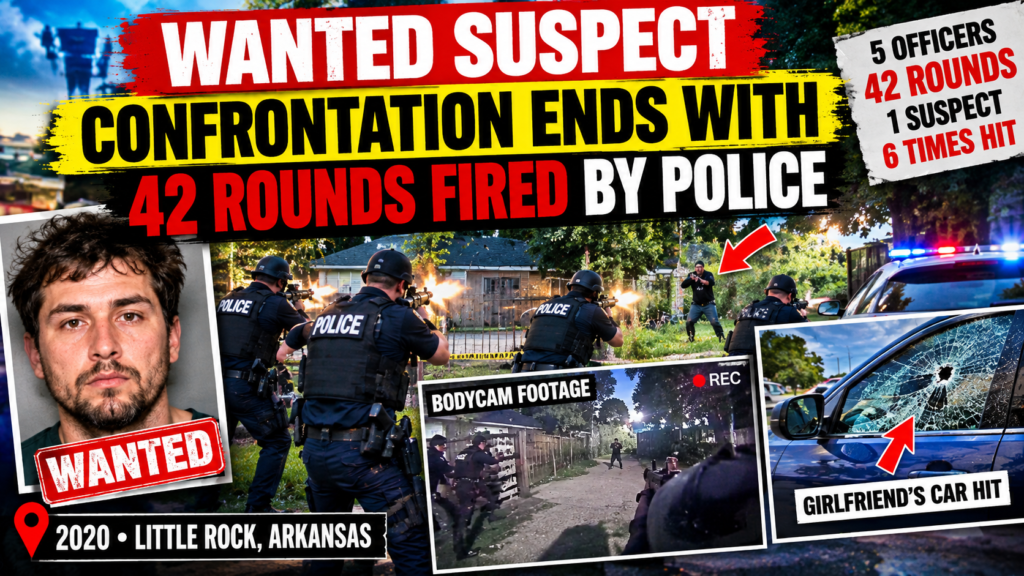
A chaotic confrontation between police and a wanted suspect in 2020 ended with officers firing a combined 42 rounds, according to the incident summary.
Five officers reportedly fired their weapons during the confrontation, striking the suspect six times.
The incident was captured on three separate body-camera recordings, providing multiple views of the moments leading up to and during the shooting.
Investigators also reported that one bullet struck the vehicle of the suspect’s girlfriend as she was driving away from the area.
The incident has raised questions about police tactics, the risks created by multiple officers firing in the same area and the split-second decisions involved when an armed confrontation develops.
What Happened During the Police Confrontation?
According to the incident summary, officers were attempting to take a wanted suspect into custody when the situation quickly escalated.
Authorities said the suspect had previously threatened to “shoot it out” with police, setting the stage for a potentially dangerous encounter.
When the confrontation began, multiple officers became involved.
Five officers ultimately fired their weapons.
Investigators determined that the officers fired a combined 42 rounds during the incident.
The suspect was hit by six bullets.
Three Body Cameras Captured the Incident
One of the most significant aspects of the case is the availability of footage from three different body cameras.
The recordings provide multiple perspectives of the confrontation rather than relying on a single officer’s account.
Body-camera footage can be particularly important in officer-involved shooting investigations because it can help investigators reconstruct the sequence of events, including officers’ movements, commands and the timing of gunfire.
However, footage from individual body cameras may not capture every part of an incident. Investigators typically consider video alongside witness statements, physical evidence, forensic analysis and officer reports.
Five Officers Fired 42 Rounds
The incident summary states that five officers fired a total of 42 rounds.
The suspect was struck six times.
The number of rounds fired has become one of the most notable details of the case, particularly because several officers were shooting during the same confrontation.
However, the total number of rounds fired does not by itself establish whether every individual shot was justified or unjustified.
To evaluate an officer-involved shooting, investigators generally examine what each officer reasonably perceived at the moment force was used, whether a threat remained active and how the situation developed from second to second.
Bullet Struck Suspect’s Girlfriend’s Vehicle
The confrontation also created a potential danger for people who were not directly involved in the shooting.
According to investigators, one round struck the vehicle belonging to the suspect’s girlfriend as she was driving away from the scene.
The incident highlights one of the major risks associated with gunfire in populated areas: bullets can travel beyond the immediate confrontation and potentially endanger bystanders or other motorists.
There was no indication in the provided incident summary that the girlfriend was struck or injured.
Suspect Was Hit Six Times
Authorities reported that the suspect was struck six times during the exchange of gunfire.
The incident summary does not, by itself, establish how many of the shots fired by individual officers struck the suspect or exactly when each officer fired.
Those details can be important when investigators reconstruct an officer-involved shooting.
The available body-camera footage provides additional evidence that can be used to examine the sequence of events.
Why Police Shootings Are Investigated
Officer-involved shootings are generally subject to investigations designed to determine what happened and whether officers followed applicable laws, policies and training.
Investigators may examine:
- Body-camera footage
- Officer statements
- Witness accounts
- Weapon and ammunition evidence
- Bullet trajectories
- Shell casings recovered at the scene
- Medical and forensic evidence
- Radio communications
- The suspect’s actions immediately before the shooting
- Individual officers’ positions and lines of fire
These factors can provide a more complete picture than simply looking at the number of rounds fired.
Does 42 Rounds Automatically Mean Excessive Force?
Not necessarily.
The 42-round figure is significant, but the number alone cannot determine whether the officers’ actions were appropriate.
For example, several officers may fire simultaneously when they perceive an ongoing threat. Officers may also continue firing until they believe the threat has stopped.
At the same time, the fact that multiple officers fired in an area where another vehicle was present raises legitimate questions about crossfire and bystander safety.
The key issue is therefore what each officer knew and perceived at the time of each shot.
The Crossfire Risk
The bullet that struck the suspect’s girlfriend’s vehicle is particularly relevant to the discussion of police gunfire.
When several officers fire weapons in the same area, investigators may examine whether officers had clear fields of fire and whether other people or vehicles were potentially positioned behind the suspect.
This is one reason police departments emphasize firearms training, target identification and awareness of surrounding people and structures.
The available information confirms that a vehicle was struck. It does not, by itself, establish that an officer violated policy or acted unlawfully.
What the Bodycam Footage Can Show
The three body-camera recordings can potentially help answer several important questions:
- What did officers know before confronting the suspect?
- Did the suspect display or use a weapon?
- Were threats made before the gunfire began?
- How quickly did the confrontation develop?
- Where was each officer positioned?
- When did each officer begin and stop firing?
- Was the suspect still considered an active threat?
- Where were other people and vehicles located?
These details are more useful for understanding the incident than the raw round count alone.
A Chaotic Scene Captured on Camera
The incident demonstrates how quickly an encounter involving a wanted suspect can escalate.
According to the incident summary, authorities were already aware of threats that the suspect might resist arrest and “shoot it out” with police.
Once the confrontation began, five officers became involved and dozens of rounds were fired.
The presence of another vehicle in the area added another layer of risk.
The three body-camera recordings therefore provide important evidence for reconstructing what happened during those critical moments.
Key Facts About the Case
| Detail | Reported Information |
|---|---|
| Year | 2020 |
| Type of incident | Officer-involved shooting |
| Suspect | Wanted suspect |
| Officers who fired | 5 |
| Total rounds fired | 42 |
| Suspect struck | 6 times |
| Body-camera angles | 3 |
| Other vehicle involved | Suspect’s girlfriend’s vehicle |
| Reported vehicle damage | Struck by one round |
| Major issue raised | Police tactics and crossfire risk |
Frequently Asked Questions
How many rounds did police fire?
According to the incident summary, five officers fired a combined 42 rounds.
How many times was the suspect shot?
Investigators reported that the suspect was struck six times.
Was the shooting captured on body camera?
Yes. The incident was captured from three separate body-camera angles.
Was anyone else in danger?
Investigators reported that one round struck the vehicle of the suspect’s girlfriend while she was driving away from the scene.
Does firing 42 rounds prove excessive force?
No. The number of rounds alone does not establish whether the officers’ use of force was lawful or consistent with policy. Each officer’s actions and the circumstances at the time of each shot have to be considered.
Why are multiple body-camera videos important?
Multiple recordings can help investigators compare different perspectives and reconstruct the timing, positions and actions of the people involved.
What are investigators likely to examine?
Investigators may examine body-camera footage, witness statements, ballistic evidence, officer reports, radio communications and the suspect’s actions before and during the confrontation.
Final Takeaway
A 2020 confrontation involving a wanted suspect ended with five officers firing 42 rounds, according to the incident summary. The suspect was struck six times, while a round also reportedly hit the vehicle of his girlfriend as she was leaving the area.
The incident was recorded by three body cameras, providing multiple perspectives of the shooting.
The case raises important questions about police tactics, officer positioning, crossfire risks and the decisions officers make during rapidly developing armed confrontations.
But the total number of shots fired should not be treated as the sole measure of whether the shooting was justified. A proper assessment requires examining what happened immediately before and during the gunfire, what each officer could reasonably perceive, whether the suspect posed an ongoing threat and whether officers followed applicable law and department policy.
The body-camera footage and investigative findings are therefore central to understanding what happened during the confrontation.