Detroit Metropolitan Airport has recorded a first for the United States after U.S. Customs and Border Protection (CBP) agriculture specialists discovered potentially destructive giant scale insects hidden on fresh pine bark brought into the country by a traveler from Cameroon.
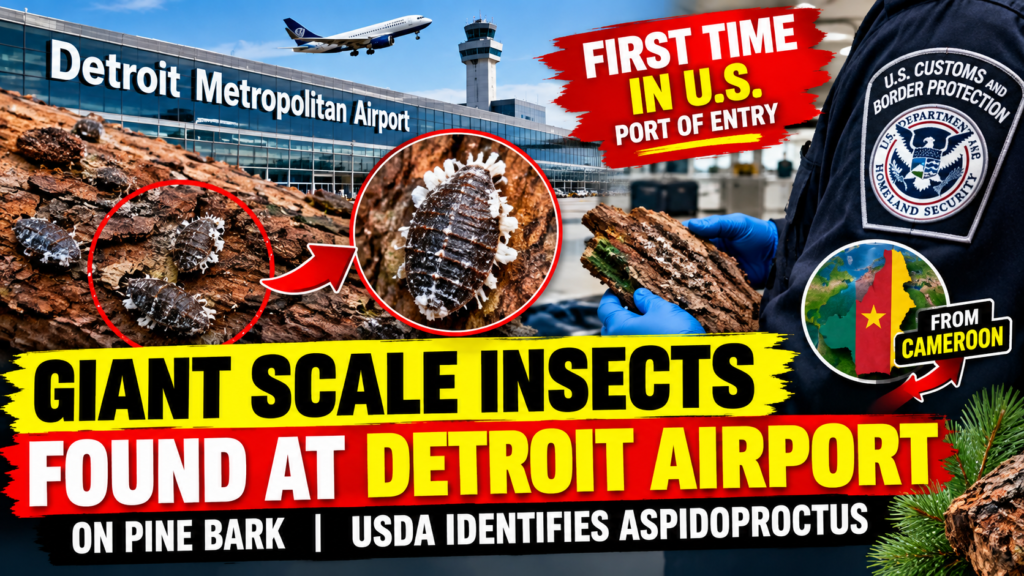
The insects were discovered during a routine luggage inspection earlier this year. The traveler was headed to Illinois, and the pine bark was reportedly being carried for medicinal purposes.
After further examination, the U.S. Department of Agriculture (USDA) confirmed on August 7 that the insects belonged to the Aspidoproctus genus. According to CBP, this was the first time insects from this group had been encountered at a U.S. port of entry.
The insects and the pine bark were seized, preventing the potentially invasive pests from continuing their journey into the United States.
Key Details
| Detail | Information |
|---|---|
| Location | Detroit Metropolitan Airport (DTW), Michigan |
| Insects | Giant scale insects |
| Genus identified | Aspidoproctus |
| Origin of traveler | Cameroon |
| Destination | Illinois |
| Material carrying insects | Fresh pine bark |
| Purpose of bark | Medicinal use |
| Discovery | Routine baggage inspection |
| Identification | USDA confirmed August 7, 2026 |
| Significance | First recorded U.S. port-of-entry interception of Aspidoproctus |
| Action taken | Insects and bark seized |
How Were the Insects Discovered?
The discovery happened during a routine inspection by CBP agriculture specialists at Detroit Metropolitan Airport.
According to CBP, the traveler was a citizen of Cameroon who was traveling onward to Illinois. During the baggage examination, agriculture specialists discovered approximately 5-millimeter-long insects feeding on the surface of fresh pine bark.
The bark had been brought into the United States for medicinal purposes.
The insects were dark in color and had distinctive light-colored, waxy protrusions on their bodies. Their unusual appearance prompted further examination by agriculture specialists and USDA officials.
USDA Confirms the Insects as Aspidoproctus
Initially, CBP and USDA personnel tentatively identified the insects as a type of giant scale insect in February.
The specimens were subsequently examined more closely. On August 7, 2026, the USDA confirmed that they belonged to the Aspidoproctus genus.
CBP said records showed that this was the first time the genus had been encountered at a U.S. port of entry.
That makes the interception significant for U.S. agricultural and environmental protection officials because the early detection prevented the insects from potentially entering the country undetected.
What Are Giant Scale Insects?
Scale insects are small plant-feeding insects that can live on trees, shrubs and other plants.
The Aspidoproctus group is notable because it includes some of the world’s largest scale insects. CBP said some species in this African genus can grow to nearly 1.5 inches long.
Many scale insects feed by sucking plant fluids. Depending on the species and host plant, infestations can weaken vegetation and cause damage to trees, shrubs and other plants.
CBP also noted that females of some giant scale species can lay more than 5,000 eggs, while tiny young insects can spread relatively easily, including through wind.
Why Are Foreign Insects a Concern?
An insect that is harmless or manageable in its native environment can potentially create problems if it becomes established in a new ecosystem.
The United States has extensive forests, agricultural operations, nurseries and natural habitats that can be vulnerable to foreign plant pests.
The USDA’s Animal and Plant Health Inspection Service (APHIS) says plant pests capable of harming forests, damaging U.S. crops or disrupting trade can require control measures when they become established in the country.
For this reason, CBP agriculture specialists inspect travelers’ luggage, cargo and agricultural products entering the United States.
The goal is to detect potentially harmful organisms before they can move beyond the port of entry.
Why the Discovery Matters to Michigan
Michigan has a major forest-products and lumber industry, making the detection of potentially damaging foreign pests particularly important to state and federal agriculture officials.
Fadia Pastilong, port director at Detroit, said agriculture specialists are on the frontline of protecting Michigan’s lumber industry and described the interception as significant because pests of this type can threaten natural resources and economic sectors.
The concern is not that this particular interception has established an infestation in Michigan. Rather, officials are emphasizing the importance of preventing foreign pests from entering and becoming established.
Because the insects were discovered at the airport and the infested material was seized, the incident was stopped at the border.
What Happened to the Insects and Pine Bark?
CBP agriculture specialists seized both the insects and the fresh pine bark for further analysis.
The traveler was informed about applicable regulations and was released without incident.
There is no indication in the reports that the insects escaped into the surrounding environment or became established in Michigan. The significance of the incident is the successful detection and interception of a previously unrecorded pest at a U.S. port of entry.
Why Travelers Should Be Careful When Bringing Plant Materials
The incident also highlights the importance of U.S. rules covering plants, plant products and other agricultural materials brought into the country.
Travelers may unknowingly carry insects, eggs, larvae, fungi or other organisms on plant materials, wood, fruits, vegetables and other agricultural products.
USDA APHIS regulates many plant pests and materials entering the United States. Depending on the organism and material involved, permits or other requirements can apply.
CBP is encouraging travelers to declare agricultural items when entering the United States.
Declaring an item allows agriculture specialists to determine whether it can legally enter the country and whether it presents a potential pest or disease risk.
A Second Unusual Pest Discovery at Detroit Airport
The Aspidoproctus interception was not the only unusual pest discovery reported at Detroit Metropolitan Airport this year.
CBS Detroit reported that in January, agriculture specialists also discovered a non-native straw crest moth, Mesophleps silacella, during a routine luggage inspection involving material from Ghana.
That means Detroit’s airport agriculture inspection operation has detected multiple non-native pests during 2026.
What This Means for U.S. Agriculture
The discovery does not mean that giant scale insects have established themselves across the United States.
Instead, it demonstrates why agricultural inspections at international airports are important.
When potentially harmful organisms are found before they leave the port of entry, officials can seize the affected material and prevent the organisms from being transported farther into the country.
USDA APHIS maintains programs designed to prevent the introduction and spread of plant pests and diseases that could affect American agriculture, forests and natural resources.
Officials’ Message to Travelers
CBP officials used the incident to remind international travelers that even seemingly harmless plant materials can carry organisms that may pose risks to U.S. agriculture and natural resources.
Travelers who bring agricultural products into the United States should declare those items to CBP officers.
The Detroit interception shows why that step matters: a small insect discovered during a luggage inspection can represent a much larger potential problem if a foreign pest is allowed to enter an environment where it has suitable hosts and few natural controls.
Final Takeaway
A routine luggage inspection at Detroit Metropolitan Airport led to the discovery of giant scale insects on fresh pine bark carried by a traveler from Cameroon.
The USDA later identified the insects as belonging to the Aspidoproctus genus, marking the first recorded encounter with the genus at a U.S. port of entry, according to CBP.
The insects and bark were seized, and the traveler was released after being advised of the applicable regulations.
The incident serves as another reminder of the role CBP agriculture specialists play in protecting U.S. forests, agriculture and natural resources from foreign plant pests.
For travelers, the message is straightforward: declare agricultural and plant materials when entering the United States and allow agriculture specialists to determine whether those materials can legally enter the country.